
Aviation Incidents: Beyond the Immediate Cause

Beyond the Immediate Cause: Using Root Cause Analysis to Prevent Aviation Incidents
Recent aviation accidents and incidents have once again placed aviation safety in the public spotlight. While commercial aviation remains one of the safest forms of transportation, every serious event is a reminder that safety must be continuously managed, reviewed, and improved.
In aviation, it is rarely enough to ask, “What went wrong?” A more important question is, “Why did the system allow it to happen?”
That is the purpose of root cause analysis.
Accidents Are Rarely Caused by One Factor
When an aviation incident occurs, early attention often focuses on the most visible issue: pilot actions, weather, mechanical failure, air traffic control, runway conditions, maintenance history, or equipment performance. These factors matter, but they are often only part of the story.
Aviation events usually involve a chain of contributing factors rather than a single isolated failure. A runway event, for example, may involve several layers of risk: aircraft configuration, approach procedures, crew workload, airfield design, lighting, vehicle control, communication, weather, training, and organizational oversight.
Looking only at the last action before the event can lead to incomplete corrective actions.
Why Root Cause Analysis Matters
Root cause analysis helps organizations move from reaction to prevention. Instead of simply correcting the visible problem, RCA identifies the underlying conditions that allowed the event to occur.
A good RCA process helps answer questions such as:
- Were procedures clear, current, and practical?
- Were personnel properly trained and qualified?
- Were known hazards previously reported but not fully addressed?
- Were controls in place but ineffective?
- Did communication, workload, fatigue, or environmental conditions contribute?
- Was there a gap between written procedures and actual field practices?
- Were corrective actions from prior events completed and verified?
These questions are especially important in high-reliability industries such as aviation, where risk is managed through multiple layers of defense.
Near Misses Deserve the Same Discipline
Not every event results in injury or damage, but near misses can provide some of the most valuable safety information. Public attention around runway incursions, close calls, and ground movement events is a reminder that organizations should treat near misses as learning opportunities, not administrative records.
A mature safety program should make it easy to report hazards, near misses, procedural deviations, equipment concerns, and unsafe conditions. Just as important, it should ensure that these reports are reviewed, trended, investigated when appropriate, and converted into meaningful preventive actions.
From Findings to Corrective and Preventive Actions
The value of an investigation is ultimately measured by what changes after it.
Corrective and preventive actions should be specific, assigned, tracked, and verified. A recommendation such as “retrain personnel” may be appropriate in some cases, but it is often not sufficient by itself.
Effective actions may include:
- Procedure revisions
- Design improvements
- Equipment changes
- Automation safeguards
- Better supervision
- Improved briefings
- Updated checklists
- Enhanced training scenarios
- Changes to risk assessment criteria
For aviation-related events, strong action management should include:
- Clear ownership and due dates
- Risk-based prioritization
- Management review of high-severity findings
- Verification that actions were completed
- Effectiveness checks after implementation
- Escalation for overdue or repeated issues
- Trend analysis across locations, fleets, departments, or event types
Without this structure, lessons learned can remain trapped in investigation reports rather than becoming operational improvements.
The Role of Safety Management Systems
Aviation organizations already understand the importance of Safety Management Systems. However, the effectiveness of an SMS depends on the quality of the information flowing through it.
Incident reports, hazard observations, audit findings, maintenance issues, training records, risk assessments, and corrective actions should not exist in separate silos. When safety data is fragmented, organizations may miss patterns that are visible only when information is connected.
For example:
- Repeated minor findings at one location may point to a training issue
- Multiple runway or ramp-related observations may point to a procedural or design concern
- Similar maintenance discrepancies across assets may indicate a broader reliability or supplier issue
An integrated system allows organizations to connect the dots earlier.
A Practical RCA Framework for Aviation Events
A strong root cause analysis process does not need to be overly complex, but it must be disciplined.
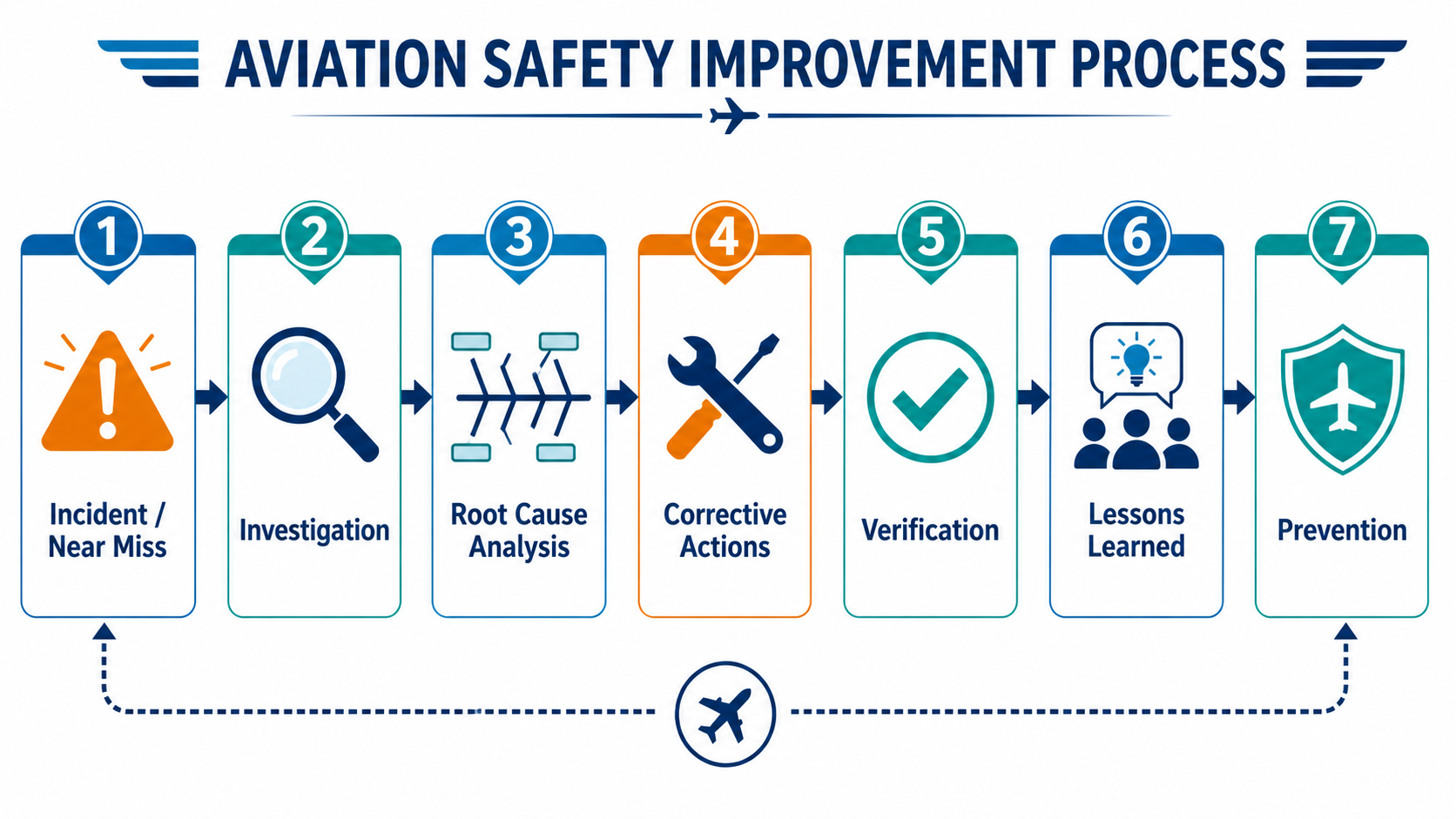
1. Incident / Near Miss
Begin with timely and accurate reporting of the event or close call. Capture essential facts while details are still fresh.
2. Investigation
Preserve the facts and establish what happened. Separate verified information from assumptions, and identify what still needs to be investigated.
3. Root Cause Analysis
Go beyond immediate causes and ask why the event was possible. Methods such as 5 Why, Fishbone/Ishikawa, cause trees, or other structured approaches can help identify deeper contributing factors.
4. Corrective Actions
Define actions that address the root causes and contributing factors, not just the symptoms. Each action should have an owner, due date, and priority.
5. Verification
Confirm that actions were completed properly and that the intended controls are actually in place.
6. Lessons Learned
Share key findings across relevant teams, sites, and operations so the same hazard does not recur elsewhere.
7. Prevention
Use the knowledge gained to strengthen procedures, training, equipment, oversight, and safety culture, reducing the likelihood of recurrence.
Technology Can Strengthen the Process
Software alone does not create a strong safety culture, but the right system can make disciplined safety management much easier.
EXP’s integrated QEHS platform helps organizations manage the complete lifecycle of safety events, including:
- Incident and near-miss reporting
- Root cause analysis using methods such as 5 Why and Ishikawa
- Corrective and preventive action tracking
- Workflow-based reviews and approvals
- Automatic reminders and escalations
- Audit and inspection findings
- Risk assessments and management review
- KPI tracking and trend analysis
- Cross-module links between incidents, actions, audits, observations, and risk data
This integrated approach is especially important for organizations that need to manage safety across multiple sites, departments, contractors, or operational units.
Prevention Starts Before the Accident
The most effective safety programs are not built around reacting to major events. They are built around identifying risk early, learning from weak signals, and ensuring that corrective actions are completed and verified.
Recent aviation incidents should not simply prompt concern. They should prompt renewed discipline around reporting, investigation, root cause analysis, and prevention.
In safety-critical operations, the goal is not only to understand what happened yesterday. The goal is to prevent the next event from happening tomorrow.
How EXP Can Help
EXP helps organizations strengthen safety management through integrated incident reporting, root cause analysis, corrective action tracking, observations, audits, risk management, and performance dashboards.
Request a Demo or Contact Us to learn more.